How Many Calories Should I Eat a Day to Lose Weight?
The honest answer isn't 1,200 or 1,500 — it depends on your body. Here is how to calculate how many calories you should eat a day to lose weight, plus the floors you should never go below.

How many calories should I eat a day to lose weight? It's one of the most searched fitness questions in the world, and almost every answer you'll find is wrong for you — because "1,200 calories" or "1,500 calories" are numbers pulled from nowhere.
Your correct calorie intake depends on your weight, height, age, sex, and activity level. A 95 kg man and a 55 kg woman need very different numbers, and giving them both 1,500 helps neither.
Here's how to work out your actual number in about two minutes.
The Two Numbers You Need
1. BMR — Your Baseline
Your basal metabolic rate is the energy your body burns doing nothing at all: breathing, circulating blood, maintaining organs. It accounts for around 60–70% of your total daily burn.
2. TDEE — Your Real Maintenance
Your total daily energy expenditure is BMR plus everything else — walking, working, training, fidgeting, digesting. This is the number that matters. TDEE is how many calories you'd eat to stay exactly the same weight.
To lose weight, you eat below your TDEE. That's the whole system.
How to Calculate How Many Calories to Eat to Lose Weight
If you want to do it by hand, use the Mifflin-St Jeor equation, which is the most accurate widely-used formula:
- Men: BMR = (10 × weight in kg) + (6.25 × height in cm) − (5 × age) + 5
- Women: BMR = (10 × weight in kg) + (6.25 × height in cm) − (5 × age) − 161
Then multiply your BMR by your activity level to get TDEE:
- Sedentary (desk job, little exercise) — × 1.2
- Lightly active (1–3 workouts a week) — × 1.375
- Moderately active (3–5 workouts a week) — × 1.55
- Very active (6–7 workouts a week) — × 1.725
- Athlete / physical job — × 1.9
Finally, subtract your deficit:
- Slow, sustainable loss (~0.25 kg/week) — TDEE − 250
- Standard loss (~0.5 kg/week) — TDEE − 500 ← recommended for most people
- Aggressive loss (~0.75–1 kg/week) — TDEE − 750 to −1000, only if you have significant weight to lose
A Worked Example
A 35-year-old woman, 70 kg, 165 cm, works at a desk, trains 3 times a week:
- BMR = (10 × 70) + (6.25 × 165) − (5 × 35) − 161 = 1,395 calories
- TDEE = 1,395 × 1.375 = 1,918 calories
- To lose weight = 1,918 − 500 = ~1,420 calories per day
And a 40-year-old man, 90 kg, 178 cm, desk job, trains 4 times a week:
- BMR = (10 × 90) + (6.25 × 178) − (5 × 40) + 5 = 1,817 calories
- TDEE = 1,817 × 1.55 = 2,816 calories
- To lose weight = 2,816 − 500 = ~2,315 calories per day
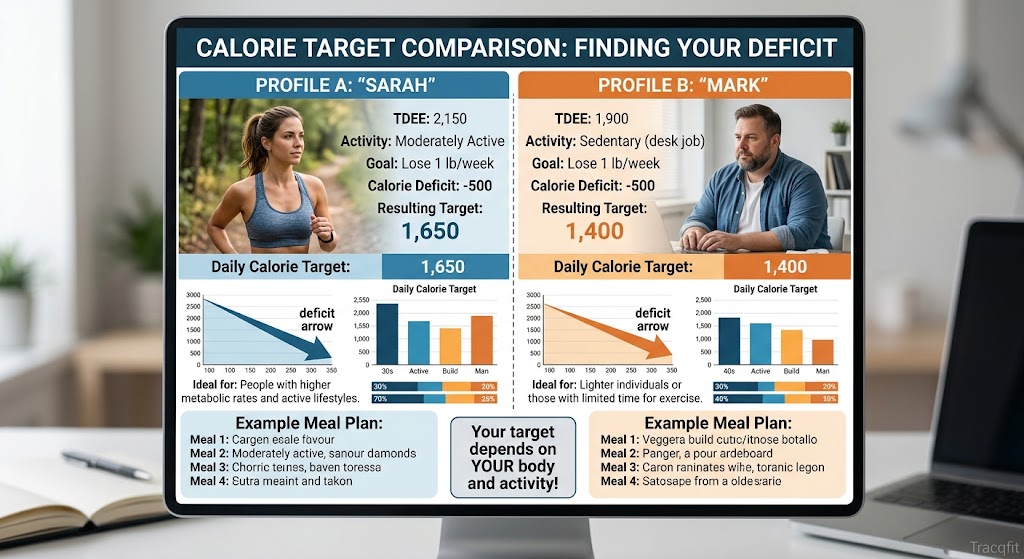
Same goal, nearly 900 calories apart. This is exactly why generic numbers fail.
The Calorie Floors You Should Never Go Below
If your calculated target lands below the floor, don't restrict further. Raise your activity instead — adding 3,000 steps a day creates roughly the same deficit without cutting food.
Why Your Calorie Target Changes Over Time
A smaller body burns fewer calories. The intake that produced a 500-calorie deficit at 90 kg is much closer to maintenance at 80 kg. This is the single most common reason weight loss stalls after two months — people keep eating their original target.
Do You Have to Count Calories Forever?
No — and most people shouldn't. Counting is a learning tool. Track carefully for 4–8 weeks and you'll build an accurate mental model of what portions look like, where hidden calories live (oils, drinks, sauces, snacks), and how much protein is in your usual meals.
After that, most people maintain results with portion awareness and a weekly weigh-in. If progress drifts, return to tracking for a couple of weeks to recalibrate.
Calories Aren't the Only Thing That Matters
A calorie deficit determines whether you lose weight. Protein and training determine whether you lose fat or muscle.
- Protein — 1.4–1.6 g per kg of body weight, to preserve muscle and control hunger
- Strength training — 2–4 sessions a week; see the beginner 4-day split
- Fibre and volume — vegetables let you eat more food for the same calories
- Sleep — under-sleeping makes any calorie target feel harder than it is
FAQ
How many calories should I eat a day to lose weight?
Take your TDEE — your maintenance calories — and subtract 500 for roughly 0.5 kg of loss per week. For most adults that lands between 1,400 and 2,400 calories depending on size, sex, and activity. Never go below 1,200 (women) or 1,500 (men).
Is 1,200 calories a day enough to lose weight?
It will produce weight loss for most people, but it's the absolute floor for adult women and it's too low for most. Very low intakes make protein and micronutrient targets hard to hit, increase muscle loss, and have poor long-term adherence. A moderate deficit produces better results you actually keep.
How many calories should I eat to lose 1 kg a week?
One kilogram of fat is roughly 7,700 calories, so a 1 kg weekly loss needs about a 1,100-calorie daily deficit. That's aggressive and only appropriate if you're carrying substantial excess weight. Most people should target 0.5 kg per week with a 500-calorie deficit instead.
Why am I not losing weight in a calorie deficit?
Usually the deficit isn't as large as you think — untracked cooking oil, drinks, sauces, and weekend meals are the common culprits. Other causes include water retention masking fat loss on the scale, and a maintenance level that dropped as you lost weight. Recalculate your TDEE and tighten tracking for a week.
Do I need to count calories to lose weight?
No, but you do need a deficit. Counting is the most reliable way to confirm you have one. Some people succeed with portion control, higher protein, and fewer liquid calories alone — but if progress stalls, tracking is how you find out why.
How often should I recalculate my calorie needs?
Every 4–5 kg of weight change, or roughly every 6–8 weeks. Your TDEE falls as your body gets smaller, so an unchanged target slowly turns into maintenance.
Where to Go From Here
Get your number in 30 seconds: the BMR & TDEE Calculator does the maths above and gives you targets for fat loss, maintenance, and muscle gain — free, no signup.