How Much Protein Do You Need to Build Muscle?
There's a real number behind "eat more protein for muscle" — here's what it is, and why more isn't automatically better.
"Eat more protein" is the most repeated advice in fitness, but almost nobody explains how much is actually enough, or why the number matters more than the source. Building muscle requires a specific amount of protein, spread out correctly, combined with training that actually challenges your muscles. Miss any one of those three, and the other two won't fully make up for it — which is why some people eat a high-protein diet for months with disappointing results and don't understand why.
The actual number
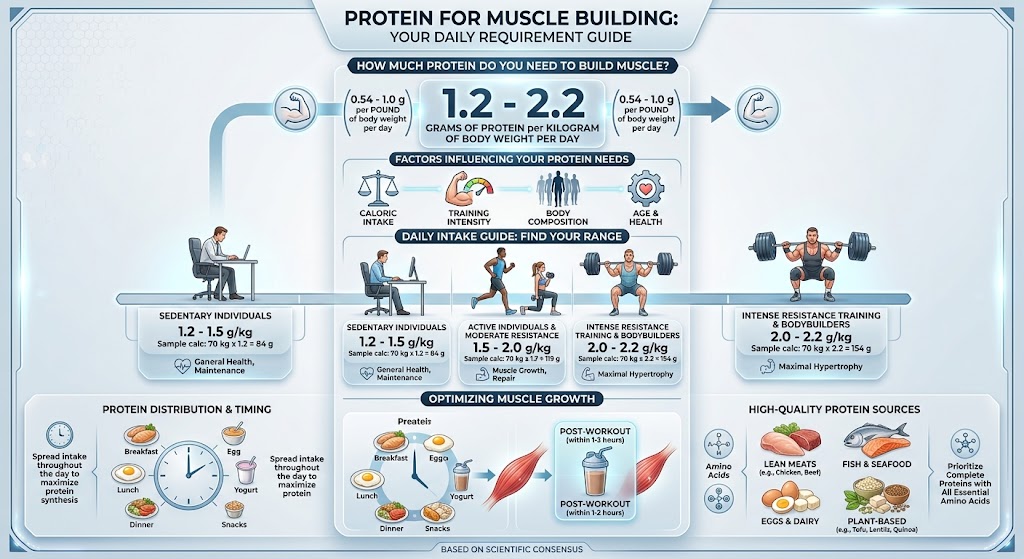
For most people actively trying to build muscle, research consistently points to a range of about 1.6-2.2 grams of protein per kilogram of body weight per day. Below that range, muscle growth is limited by protein availability. Above roughly 2.2 g/kg, extra protein mostly just gets used for energy rather than additional muscle — there's a ceiling past which more protein stops helping and just becomes an expensive way to eat calories.
For someone weighing 70 kg, that works out to roughly 110-155 grams of protein a day. It sounds like a lot until you spread it across 4 meals, at which point it's about 25-40 grams per meal — one chicken breast, or a scoop of protein powder with a cup of milk, or a generous portion of lentils with paneer. Written out as a daily list rather than a single scary number, it stops feeling unreasonable.
People training for size, more commonly known as hypertrophy training, tend to sit toward the higher end of that range, especially if they're also in a calorie deficit at the same time, since dieting increases the body's protein needs to protect existing muscle.
Why timing and spread matter
Your body can only use a limited amount of protein at once for muscle repair — roughly 25-40 grams per meal for most people, depending on body size. Eating your entire day's protein in one meal wastes a large portion of it. Spreading protein across 3-5 meals gives your body a steady supply of building material throughout the day, which matters more than hitting protein right after a workout.
- Aim for a protein source at every meal, not just post-workout
- Spread intake across 3-5 meals rather than 1-2 large ones
- Don't panic if you miss the "anabolic window" — total daily intake matters more than exact timing
- Combine protein with resistance training — protein alone, without training that stresses the muscle, won't build size
- Keep a consistent daily pattern rather than swinging between very high and very low protein days
Protein builds the material. Training gives the signal to use it. You need both.
Protein source doesn't matter as much as total intake
Whey, chicken, eggs, lentils, tofu, paneer — as long as total daily protein and training are in place, the specific source matters far less than people assume. Animal sources are complete proteins by default; plant sources can be combined (like rice and dal, or beans and grains) across the day to cover the same amino acid profile. There's no single "best" source — there's the source you'll actually eat consistently for months, since muscle building is a slow process that rewards routine over any single perfect meal.
What actually builds the muscle
Protein alone is a raw material, not an instruction. The signal that tells your body to use that protein to build new muscle tissue comes from resistance training — lifting weights, doing bodyweight exercises against resistance, or any activity that puts your muscles under a meaningful load they're not fully used to. Without that training stimulus, extra protein largely just gets used for energy or stored, the same as any other macronutrient in excess.
This is why "eating more protein" without a structured training plan rarely produces visible muscle gain. The two have to work together — training creates the demand, protein supplies what's needed to meet it, and recovery (sleep, rest days) is when the actual rebuilding happens.
Sleep and recovery's role in the equation
Muscle isn't built in the gym — it's built during recovery, particularly during deep sleep, when growth hormone release is highest. Someone hitting their protein target and training hard but sleeping five hours a night will grow muscle noticeably slower than someone doing the same training and eating on 7-8 hours of consistent sleep. Protein intake gets most of the attention because it's easy to quantify, but recovery quality deserves nearly equal weight in the conversation.
Does age or gender change the target
The 1.6-2.2 g/kg range holds up reasonably well across most healthy adults, but a couple of adjustments are worth knowing. Older adults tend to need slightly more protein than younger adults to achieve the same muscle-building response, a phenomenon researchers call anabolic resistance — the body becomes somewhat less efficient at using protein for muscle repair with age, so leaning toward the higher end of the range makes sense past roughly age 50. Gender doesn't change the target itself; the gram-per-kilogram range applies the same way to men and women, since it's already scaled to body weight. What differs between individuals is usually training experience and total muscle mass, not sex.
Beginners often see faster early progress on a given protein and training routine than more experienced lifters, a pattern sometimes called "newbie gains." This isn't a sign the protein target should be different for beginners — it's simply that untrained muscle responds faster to any reasonable stimulus, and that rate of progress naturally slows as you get closer to your genetic potential.
Common mistakes
- Only tracking protein around workouts and ignoring the rest of the day — fix: plan protein into every meal, not just post-gym
- Assuming more protein always means more muscle — fix: stick to the 1.6-2.2 g/kg range; extra beyond that isn't doing more
- Skipping resistance training and expecting protein alone to build muscle — fix: protein without a training stimulus mostly just gets used or stored as fat
- Under-eating overall calories while trying to "eat clean" — fix: muscle building requires enough total calories, not just enough protein
- Switching protein sources constantly, chasing the "best" one — fix: pick sources you'll eat consistently over months
- Neglecting sleep while chasing perfect nutrition — fix: treat 7-8 hours of sleep as part of the muscle-building plan, not separate from it
How to know it's working
- Strength on your main lifts increasing over weeks, not just staying flat
- Body weight increasing slowly and steadily if you're in a surplus, or holding steady with visible muscle definition improving if you're maintaining
- Recovery between workouts feeling reasonable, not constantly sore or drained
- Measurements (arms, shoulders, thighs) trending up slightly over months
- Training performance improving session to session, not just some days feeling random
What actually limits muscle growth for most beginners
For someone new to structured training, protein intake is rarely the limiting factor once it's in a reasonable range. The bigger limiters are usually training consistency, whether the training program applies enough challenge over time (a principle called progressive overload), and total calorie intake. Chasing an extra 20 grams of protein a day tends to produce far less benefit than fixing an inconsistent gym schedule or a training plan that never gets harder as you get stronger. Protein is necessary but not sufficient — it removes a ceiling on growth, it doesn't create growth by itself.
FAQ
Do I need a protein supplement to build muscle? No, it's a convenience tool, not a requirement. Whole food can cover the full target — a supplement just makes hitting it easier on busy days or when appetite is lower than usual.
Is 2 grams per kilogram enough, or should I eat more to be safe? 2.0-2.2 g/kg comfortably covers virtually everyone, including people training hard. Going well beyond that has not been shown to build muscle any faster, and it usually just displaces calories that could go toward carbs supporting your training.
Can I build muscle on a vegetarian diet? Yes. Combining lentils, dal, paneer, tofu, and dairy across meals can meet the same protein targets as a non-vegetarian diet, and a plant-based protein supplement can help close any remaining gap on busier days.
How long before I see visible muscle growth? Strength gains typically show up within the first few weeks as your nervous system adapts to the training. Visible muscle growth takes longer — most people notice meaningful changes around 8-12 weeks of consistent training and adequate protein, with the pace varying by individual.
Putting it together
- Calculate your target using 1.6-2.2 g/kg of body weight
- Spread that total across 3-5 meals through the day
- Pair it with resistance training 3-4 times a week
- Protect 7-8 hours of sleep as part of the plan, not an afterthought
- Reassess your target every time your body weight shifts meaningfully
The protein number isn't complicated once you know it — the hard part is doing it consistently for months. If you want a training and meal plan built around your exact numbers, with a coach checking your progress, check our 12-week program.