Intermittent Fasting for Beginners: The Complete 16:8 Guide
Intermittent fasting doesn't burn fat by magic — it works because it makes eating less easier. Here is a beginner's guide to 16:8 intermittent fasting: how to start, what breaks a fast, and who should skip it.
Intermittent fasting is one of the most searched diet approaches in the world, and also one of the most misunderstood. It is not a diet in the usual sense — it doesn't tell you what to eat. It only tells you when.
This beginner's guide to intermittent fasting covers how it actually works, the 16:8 method step by step, what genuinely breaks a fast, and the honest answer to whether intermittent fasting is better than just eating less.

What Is Intermittent Fasting?
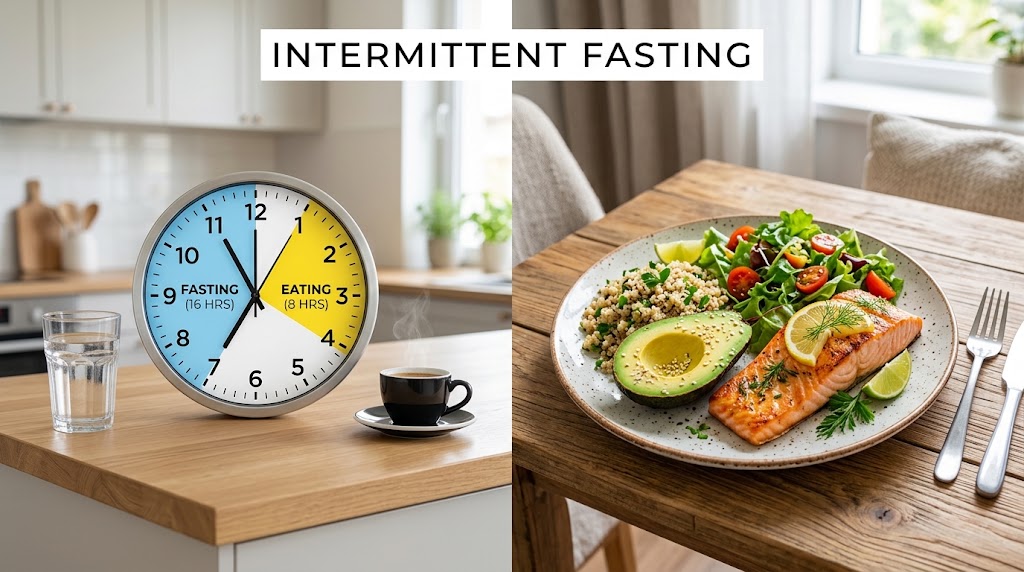
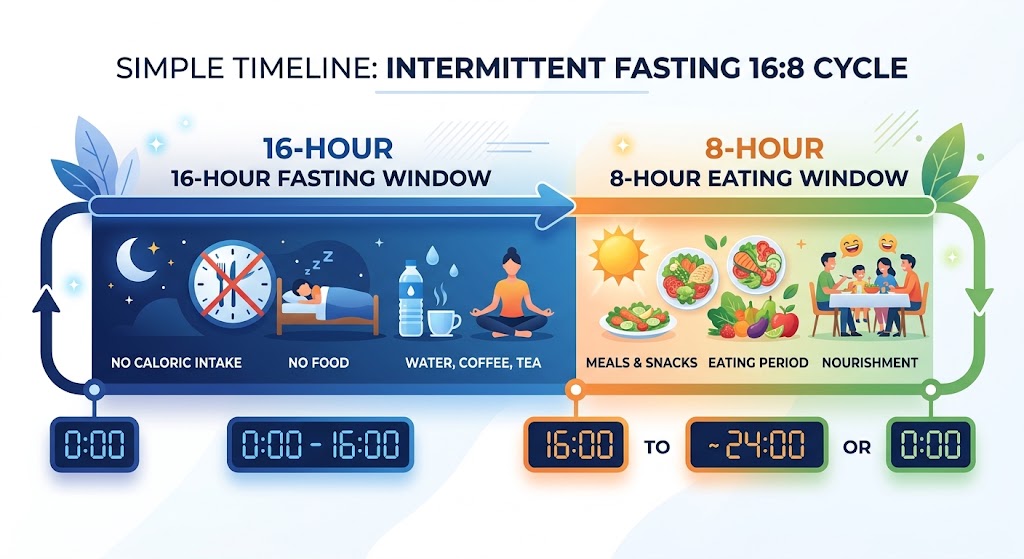
Intermittent fasting is an eating pattern that alternates periods of eating with periods of not eating. You're not fasting for days — in the most common version you're simply not eating for 16 hours, most of which you spend asleep.
The popular intermittent fasting methods:
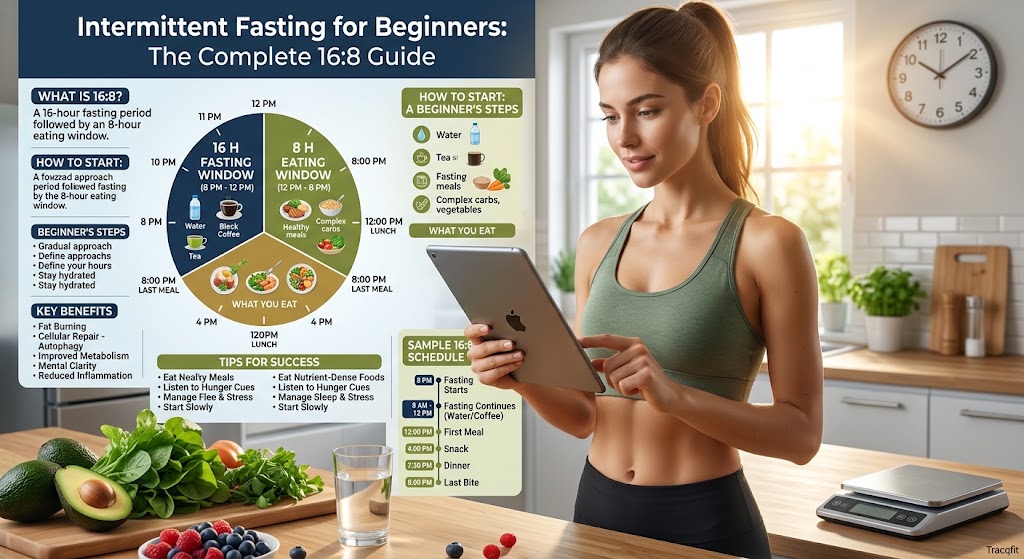
- 16:8 — fast for 16 hours, eat within an 8-hour window. The most popular and the easiest to sustain.
- 14:10 — a gentler version, good for beginners.
- 5:2 — eat normally 5 days a week, restrict to ~500–600 calories on 2 non-consecutive days.
- OMAD (one meal a day) — a 23-hour fast. Very restrictive and hard to hit protein targets on.
For almost everyone starting out, 16:8 intermittent fasting is the right choice.
How Intermittent Fasting Actually Works for Fat Loss
Here's the part the marketing skips: intermittent fasting does not have a magic fat-burning mechanism. When researchers compare intermittent fasting to regular calorie restriction with calories and protein matched, fat loss comes out about the same.
So why does it work for so many people? Because compressing eating into 8 hours makes it genuinely harder to overeat. You skip breakfast, you skip late-night snacking, and you naturally eat 300–500 fewer calories without counting anything.
If you want the underlying mechanism, read Calorie Deficit Explained.
How to Start 16:8 Intermittent Fasting
- Pick your eating window. 12pm–8pm is the most common. If you train in the morning or hate skipping breakfast, 10am–6pm works just as well.
- Ease in. Start at 12:12, move to 14:10 after a week, then 16:8. Jumping straight to 16 hours is why most people quit in three days.
- Drink during the fast. Water, black coffee, and plain tea are all fine and all help with hunger.
- Don't treat the window as a free pass. Two large meals plus a snack, built around protein and vegetables. The window controls timing, not quality.
- Hit your protein target. This is the hardest part of intermittent fasting — 100–150 g in two meals takes deliberate planning.
What Breaks a Fast?
This is the most common beginner question about intermittent fasting, and the answer depends on your goal. If your goal is fat loss (not autophagy research protocols), the practical rule is: anything with meaningful calories breaks the fast.
- Does not break your fast — water, sparkling water, black coffee, plain tea, zero-calorie electrolytes
- Breaks your fast — milk or cream in coffee, sugar, juice, smoothies, protein shakes, BCAAs, anything with calories
- Debatable, practically fine — a splash of milk (under ~20 calories) won't undo a fat-loss protocol, even if it technically ends the fasted state
Real Benefits of Intermittent Fasting
- Simplicity — fewer meals to plan, prep, and decide on
- Easier calorie control — most people eat less without tracking
- Stable energy for some — no post-lunch crash, though this varies a lot by person
- Improved insulin sensitivity — shown in several studies, though partly explained by the weight loss itself
- No food rules — you don't have to give up any food group
And the Honest Downsides
- Hard to hit protein in two meals — this is the biggest practical problem
- Hunger in the first 1–2 weeks while your hunger hormones adjust
- Poor fit for morning trainers — lifting fasted at 6am with no food until noon hurts performance
- Can trigger binge patterns in people with a history of restrictive eating
- Social friction — breakfast meetings, family dinners, travel
Who Should Not Try Intermittent Fasting
Is Intermittent Fasting Better Than Normal Dieting?
For fat loss specifically: not inherently. The research consistently shows equivalent results when calories are matched.
But "equivalent on paper" and "equivalent in your life" are different things. If skipping breakfast makes it effortless for you to eat less, intermittent fasting is better for you. If it makes you ravenous and prone to overeating at night, it's worse. The best eating pattern is the one you can run for a year without thinking about it.
FAQ
What is the best intermittent fasting schedule for beginners?
16:8 — a 16-hour fast with an 8-hour eating window, most commonly 12pm to 8pm. Start with 12:12 for a week, move to 14:10, then 16:8. Easing in dramatically improves the odds you'll stick with it.
Does coffee break intermittent fasting?
Black coffee does not break a fast — it has essentially no calories and may slightly blunt hunger. Adding milk, cream, sugar, or syrup does add calories and ends the fasted state, though a small splash of milk won't meaningfully affect fat-loss results.
Can you lose weight with intermittent fasting without counting calories?
Many people do, because an 8-hour window naturally cuts 300–500 calories a day. But it isn't guaranteed — if you eat enough inside the window to exceed your maintenance calories, you won't lose fat. Intermittent fasting makes a deficit easier, it doesn't create one automatically.
How long does it take to see results from intermittent fasting?
Most people notice reduced bloating and slightly lower weight within 1–2 weeks (partly water), with genuine fat-loss results visible by 4–8 weeks. The rate depends entirely on the size of your calorie deficit, not on the fasting itself.
Will intermittent fasting make me lose muscle?
Only if your protein intake is too low or you're not strength training. Hitting 1.4–1.6 g of protein per kg of body weight and lifting 2–4 times a week protects muscle. The muscle risk with intermittent fasting comes from the difficulty of fitting enough protein into two meals, not from the fasting itself.
Can I work out while intermittent fasting?
Yes. Low- and moderate-intensity training fasted is fine for most people. Heavy strength training or long, hard sessions usually feel better with food beforehand — in that case, shift your eating window so it opens before you train.
Where to Go From Here
Not sure your eating window is actually creating a deficit? Tracqfit gives you a calorie and protein target from your own numbers, so you can see whether 16:8 is working or just feeling like it is.