PCOS (Now PMOS) Weight Loss: A Realistic Indian Diet and Workout Plan
PCOS — renamed PMOS in 2026 — makes fat loss harder, but not impossible. Insulin resistance, cravings, and slow progress all have practical workarounds. Here is a PCOS-friendly Indian diet and training plan you can actually follow.
If you have PCOS, you already know the frustrating part: you can follow the same diet as a friend without PCOS, do the same workouts, and lose weight at half the rate — or not at all for weeks.
That is not in your head, and it is not a discipline problem. Insulin resistance affects roughly 70% of women with PCOS, and it makes the body store fat more readily and burn it more reluctantly.
What follows is a plan built around that reality instead of pretending it does not exist.
Why PCOS Makes Weight Loss Harder
- Insulin resistance — your cells respond poorly to insulin, so your body produces more of it. High insulin promotes fat storage, especially around the abdomen, and blocks fat release.
- Higher androgens — shift fat storage toward the belly rather than the hips.
- Stronger cravings — blood sugar swings drive real, physiological carb cravings, not weakness.
- Inflammation — low-grade chronic inflammation is common with PCOS and adds to insulin resistance.
Principle 1: Protein and Fibre at Every Single Meal
This is the highest-leverage change for PCOS. Protein and fibre blunt the blood sugar spike from carbohydrates, which lowers the insulin response and reduces the crash-and-crave cycle two hours later.
Target 1.4–1.6 g protein per kg of body weight, and never eat a carbohydrate on its own.
- Plain toast → toast with eggs or paneer
- Poha alone → poha with sprouts and curd
- Fruit alone → fruit with a handful of nuts
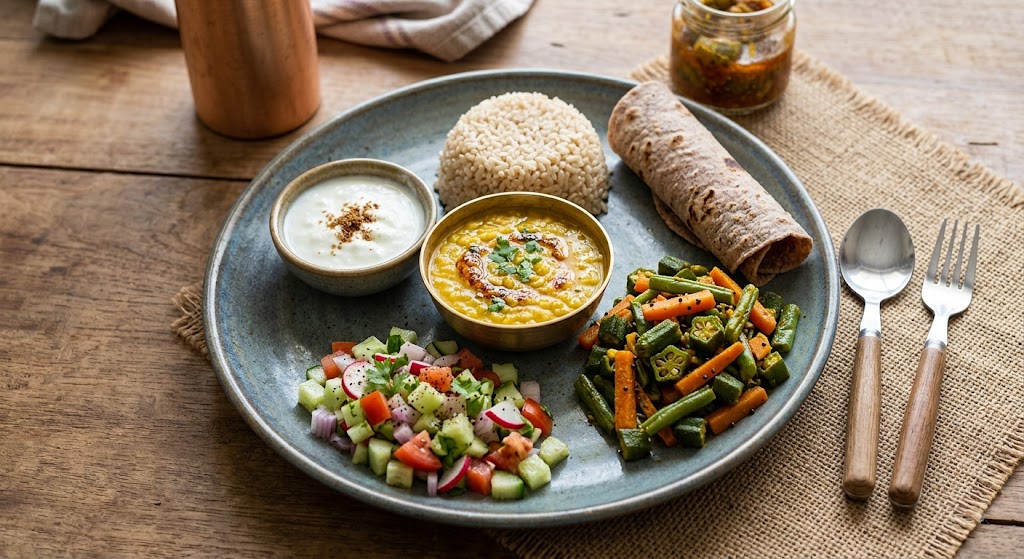
- Rice and dal → rice, dal, plus curd and a large salad
The Indian meal barely changes. What changes is what sits next to the carbohydrate.
Principle 2: Choose Slower Carbs (Don't Eliminate Them)
Low-carb is not required for PCOS, and very restrictive diets tend to backfire in binges. What matters is the type and the company the carbs keep.
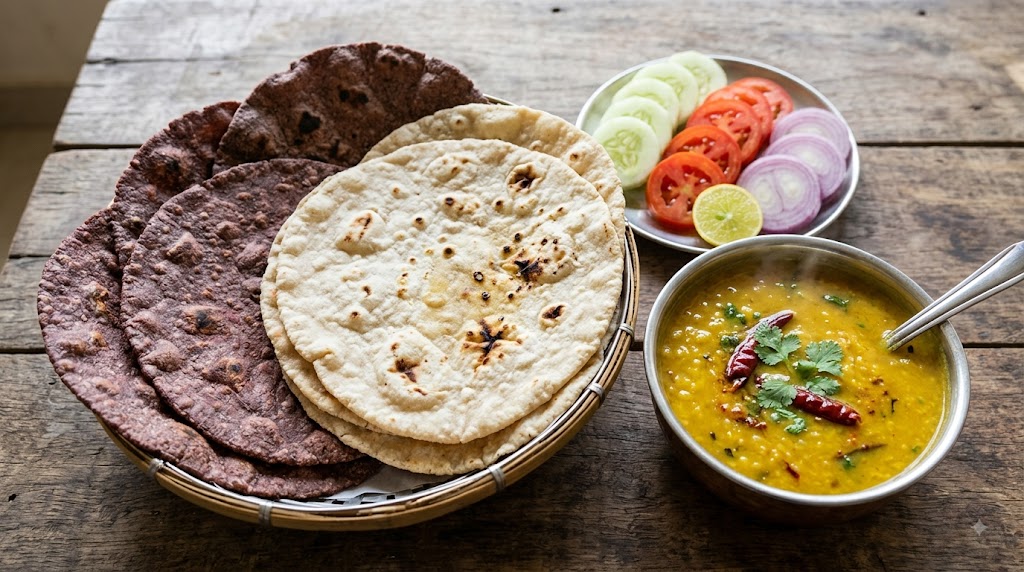
- Better — millets (ragi, jowar, bajra), oats, whole dals, rajma, chana, sweet potato, vegetables, brown/hand-pounded rice, multigrain roti
- Limit — maida (bread, naan, biscuits, bakery), sugar, sweets, fruit juice, sweetened drinks, deep-fried snacks
- Fine in portions — white rice with dal and vegetables, 2 rotis, a banana after a workout
Millets deserve a mention: ragi and jowar rotis have more fibre and a gentler blood sugar response than refined wheat, and they are ordinary Indian food, not a health-store purchase.
Principle 3: Strength Training Beats Cardio Here
This surprises people who have been told to do an hour of cardio daily. Muscle is the body's largest site for disposing of blood glucose — building more of it directly improves insulin sensitivity.
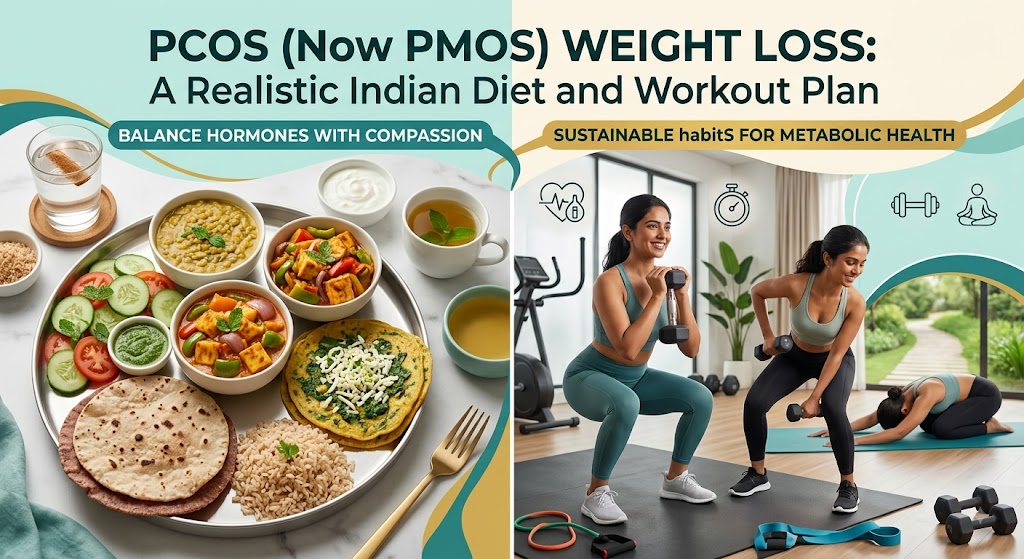
- 3 strength sessions a week, full body, 40 minutes
- Daily walking, 7,000–10,000 steps — a 20-minute walk after dinner measurably lowers post-meal blood sugar
- Go easy on daily HIIT — with PCOS, excessive high-intensity work can raise cortisol and stall progress
If a gym is not an option, the home workout plan for beginners covers the same movement patterns with bodyweight.
A PCOS-Friendly Day of Indian Eating
- Breakfast — 2 besan or moong dal chilla with paneer + a bowl of curd (protein-anchored, low spike)
- Mid-morning — a handful of almonds/walnuts, or buttermilk
- Lunch — 2 ragi or jowar roti + 1 katori dal + sabzi + big salad + curd
- Evening — roasted chana or sprouts chaat + green tea (skip the biscuits with chai)
- Dinner — grilled paneer / soya / chicken + stir-fried vegetables + a small portion of rice, eaten earlier rather than at 11 pm
- After dinner — a 20-minute walk
Nothing here is exotic, imported, or expensive. That is deliberate — a PCOS plan you cannot cook on a Wednesday night is not a plan.
Principle 4: Sleep and Stress Are Part of the Treatment
With PCOS, these are not optional add-ons. Poor sleep directly worsens insulin resistance, and chronic stress raises cortisol, which worsens it further.
- 7–8 hours of sleep, consistent timings
- Do not stack a hard deficit, daily intense cardio, and 5 hours of sleep — with PCOS that combination reliably stalls progress
- Walking, yoga, and breathing work genuinely help here; they are not filler advice
Set Expectations Correctly
Women with PCOS often lose weight more slowly than women without it, and the scale is more erratic because of water retention linked to hormonal shifts.
- Realistic rate — 0.3–0.5 kg per week
- Judge by the 7-day average, never single weigh-ins
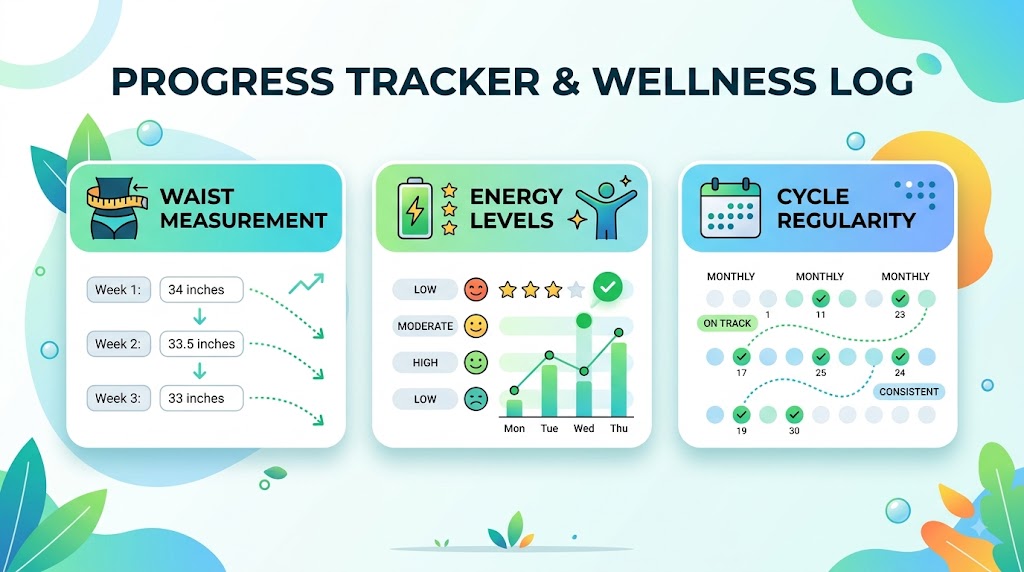
- Track non-scale wins — cycle regularity, energy, skin, waist measurement, strength in the gym. With PCOS these often improve before the scale moves meaningfully.
A 4 kg loss that regularises your cycle is a bigger win than an 8 kg crash diet that stops it.
What About Supplements?
Inositol, vitamin D, and omega-3 come up constantly in PCOS discussions, and some have reasonable evidence behind them — but dosing and suitability depend on your bloodwork and any medication you are on.
The 12-Week Starting Point
- Weeks 1–2 — add protein to every meal. Change nothing else. Log what you eat.
- Weeks 3–4 — swap refined carbs for millets/whole grains at two meals a day; start a 20-minute post-dinner walk.
- Weeks 5–8 — begin 3 strength sessions a week; set a moderate 400–500 kcal deficit using the BMR & TDEE Calculator.
- Weeks 9–12 — hold it steady. Track waist, energy, and cycle alongside weight.
Four to six kilos over 12 weeks with PCOS is a genuinely good outcome — and it is often enough to shift symptoms.
FAQ
Is PCOS now called PMOS?
Yes. In May 2026 an international consensus group renamed polycystic ovary syndrome (PCOS) to polyendocrine metabolic ovarian syndrome (PMOS), published in The Lancet and supported by the Endocrine Society and ASRM. The name changed because the old one wrongly implied the condition is mainly about ovarian cysts, when it is actually a multisystem endocrine and metabolic condition. Nothing about diagnosis or treatment changed. Guidelines in 195 countries are expected to adopt the new term over roughly three years, so both names will be in use for a while.
Why is it so hard to lose weight with PCOS?
Around 70% of women with PCOS have insulin resistance, which means higher circulating insulin, easier fat storage around the abdomen, and stronger carb cravings. It is a real physiological headwind — weight loss is slower, but it still follows the same calorie-deficit rules once the diet is built to keep insulin steady.
How much weight do I need to lose to improve PCOS symptoms?
Research consistently points to 5–10% of body weight as the threshold where symptoms such as cycle irregularity and insulin sensitivity begin to improve. For most women that is 4–7 kg, not a dramatic transformation.
Do I have to go low-carb or keto for PCOS?
No. Very restrictive diets are hard to sustain and often lead to binge cycles. What works better is choosing slower-digesting carbohydrates — millets, whole dals, vegetables — and always pairing them with protein and fibre so the blood sugar response stays flat.
What is the best exercise for PCOS weight loss?
Strength training three times a week, plus daily walking. Muscle improves insulin sensitivity directly. Excessive daily high-intensity cardio can raise cortisol and work against you, so it should not be the main strategy.
Can I lose weight with PCOS without medication?
Many women do, through diet, strength training, sleep, and stress management. Medication such as metformin is prescribed for some, and that decision belongs to your doctor. Nutrition and training help either way and are usually recommended alongside any prescription.
Where to Go From Here
Want support that accounts for slower progress? Tracqfit tracks weight trends, waist, and protein together — so a flat scale week does not look like failure when everything else is improving.