Weight Loss Plateau: Why It Happens and How to Break It
A stalled scale doesn't mean your diet stopped working. Here's what actually causes a plateau, and how to break through it properly.
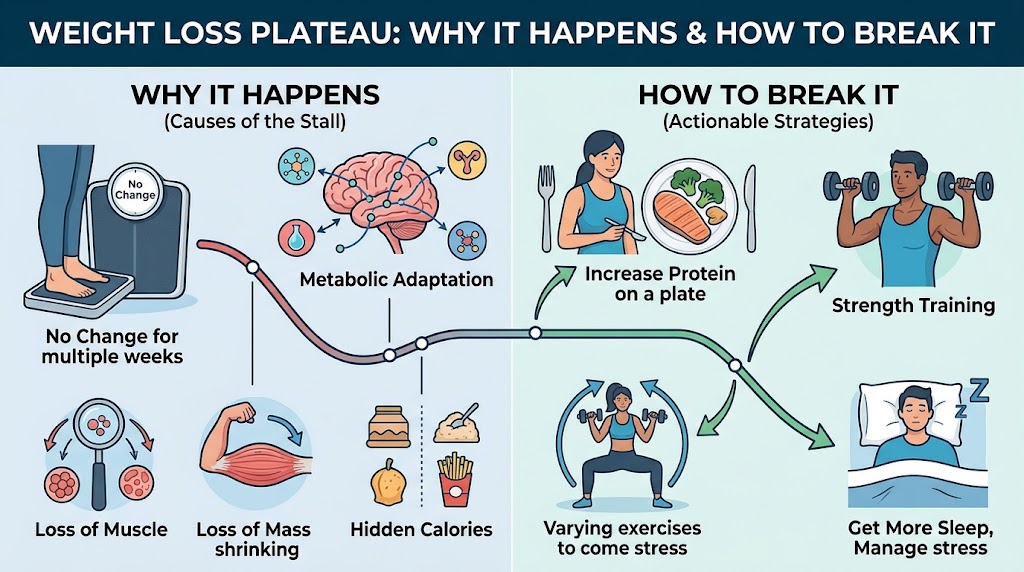
A weight loss plateau is the single most common reason people quit a diet that was actually working. The scale stops moving for a couple of weeks, motivation drops, and the natural conclusion feels like "this isn't working anymore." In most cases, that conclusion is wrong. Plateaus are a normal, predictable part of losing weight, and they almost always have a specific, fixable cause.
Why plateaus happen
The most common cause is the simplest one: as you lose weight, your body needs fewer calories to maintain itself, so a calorie intake that created a deficit at your starting weight can quietly become your new maintenance level a few months later. You didn't stop losing weight because your body "adapted" in some mysterious way — you most likely need fewer calories now than you did when you started, and your intake hasn't caught up to that change. This is normal physics, not a metabolic malfunction.
A second common cause is portion creep. Over weeks or months, small increases in portion sizes, forgotten snacks, or looser tracking add up without feeling like a conscious change. A handful of nuts here, a slightly bigger serving there — none of it feels significant in the moment, but it can fully erase a modest deficit.
Water retention is a third, more temporary cause. Higher sodium intake, hormonal fluctuations, increased training intensity, or even just stress can cause your body to hold onto extra water for days or weeks, masking fat loss that's actually still happening underneath.
How to tell which kind of plateau you're dealing with
- Check if your weight has genuinely stalled for 3+ weeks, not just a few days — short stalls are usually normal fluctuation
- Review your food tracking honestly — has portion size or frequency crept up since you started?
- Check your training consistency — has activity level dropped without you noticing?
- Consider recent stress, sleep, or hormonal factors that could be causing water retention
- Recalculate your maintenance calories based on your current weight, not your starting weight
Most plateaus fall into one of these categories, and each has a different fix — which is why "just eat less" isn't always the right first move.
A stalled scale is data, not failure. The fix depends on which kind of stall it actually is.
The fix for each type
If your maintenance calories have simply dropped because you're lighter now, the fix is a modest further reduction — another 100-200 calories a day, or a corresponding increase in activity, recalculated for your current weight rather than your starting one.
If portion creep is the issue, the fix is tightening tracking for a couple of weeks to see where the drift happened, rather than cutting calories further on top of an inaccurate baseline. Often the deficit was never broken — the actual intake just drifted away from the planned one.
If water retention looks like the cause — a stall right after a high-sodium week, increased training soreness, or a predictable point in a monthly cycle — the fix is usually patience. Continue the plan as is for another 1-2 weeks and the scale typically catches up to reflect the fat loss that was happening the whole time underneath the water weight.
When to actually change something versus wait it out
A genuine plateau that calls for action has usually lasted 3-4 weeks with consistent tracking and no obvious water-retention explanation. A stall shorter than that, or one that coincides with an identifiable cause like a high-sodium meal or a harder training week, usually resolves on its own within days. Reacting too quickly to a short stall by cutting calories further is one of the most common ways people turn a mild, temporary slowdown into an unnecessarily aggressive, harder-to-sustain diet.
The mental side of a plateau
Plateaus are as much a motivation problem as a physiological one. Weeks of visible progress build momentum, and a sudden stall — even a completely normal one — can feel like proof the whole effort has stopped paying off, which is exactly the moment many people either quit or overcorrect with an overly aggressive cut. Recognizing that a plateau is a predictable, well-understood part of the process, not a sign of personal failure, makes it much easier to respond with a small, calm adjustment instead of an emotional one. Keeping a simple log of measurements and progress photos alongside scale weight helps during these stretches, since it often shows continued change the scale alone is hiding.
How often to expect a plateau
For someone losing weight steadily over several months, a plateau of some length roughly every 4-8 weeks is a common, unremarkable pattern — not a sign that anything unusual is happening. Each one tends to resolve within 1-3 weeks once addressed correctly, and the overall downward trend continues across the following months even though the week-to-week picture looks flat during these stretches.
Common mistakes
- Cutting calories drastically the moment the scale stalls — fix: confirm it's a genuine plateau over 3+ weeks first
- Ignoring portion creep and assuming the plan itself has failed — fix: re-tighten tracking for 1-2 weeks before changing the plan
- Panicking over normal water retention — fix: judge trends over weeks, not days
- Adding excessive extra cardio as the only fix — fix: consider calories, sleep, and stress before adding more exercise volume
- Giving up entirely instead of making a small, targeted adjustment — fix: a plateau almost always needs a small correction, not a complete restart
- Not recalculating maintenance calories as body weight drops — fix: reassess every 5-7 kg lost
How to know the fix is working
- Weekly average weight resuming a downward trend within 1-3 weeks of the adjustment
- Waist and other measurements shrinking again, even before the scale confirms it
- Energy and hunger staying manageable despite the small calorie reduction
- Training performance holding steady rather than dropping sharply
A simple weekly check-in routine
Rather than reacting to daily scale readings, a short weekly review catches plateaus early without causing unnecessary anxiety. Compare this week's average weight to last week's, glance at whether portions or tracking accuracy have drifted, note any unusual sodium, stress, or training changes, and only make an adjustment if the trend has genuinely been flat for three or more of these weekly check-ins in a row. This single habit — reviewing weekly rather than daily — removes most of the emotional volatility that turns a normal plateau into a reason to quit.
FAQ
How long counts as a real plateau? Most coaches and researchers consider 3 weeks or more of no meaningful change, with consistent tracking, a genuine plateau worth addressing. Anything shorter is usually normal fluctuation.
Should I add more exercise or eat less food to break a plateau? Either can work, but eating less is usually the more reliable first move, since exercise increases can be inconsistent to track and can also increase hunger, partially offsetting the extra calories burned. A moderate reduction in food intake is easier to control precisely.
Is it normal to plateau more than once during a diet? Yes, completely normal. Most people who lose a significant amount of weight go through several plateaus along the way as their maintenance calories keep shifting downward with their body weight.
Could a plateau mean something is medically wrong? Occasionally, but it's uncommon. A plateau that persists for months despite genuinely careful tracking and adjustment, especially alongside other symptoms like unusual fatigue, can be worth discussing with a doctor to rule out a thyroid or hormonal issue.
Why increasing exercise isn't always the right fix
It's tempting to respond to a stall by adding more cardio or training harder, and sometimes that helps — but it comes with a hidden cost that often gets missed. More exercise volume tends to increase hunger and can make it harder to hold a tight food deficit, partially or fully cancelling out the extra calories burned. It also adds fatigue on top of an already demanding routine, which can hurt sleep and recovery. Before adding training volume, it's usually worth exhausting the food-side adjustments first — they tend to be more precise, more sustainable, and less likely to backfire through increased appetite.
Putting it together
- Confirm the stall has lasted 3+ weeks before making changes
- Rule out portion creep by tightening tracking for a couple of weeks
- Rule out water retention by checking recent sodium, training, and stress patterns
- Recalculate maintenance calories for your current weight and adjust by 100-200 calories if needed
- Give any adjustment 2-3 weeks before judging whether it worked
A plateau feels like failure in the moment. In almost every case, it's just your body needing the plan recalibrated to where you are now, not where you started. If you want your calories recalculated properly and a coach checking in when the scale stalls, check our 12-week program.