What to Eat and Lift While You're on GLP-1s
Protein targets by month, meal timing for near-zero appetite, and a training plan built for GLP-1 users — from month one through maintenance.
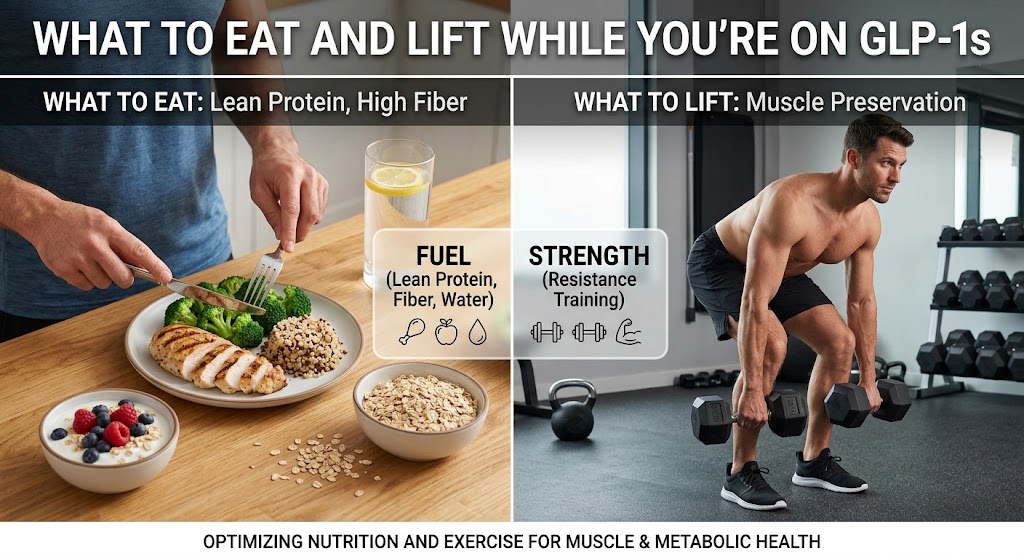
You've read the warning: GLP-1 weight loss can take a big bite out of your muscle if you're not careful. Fine — but what does "eat enough protein and lift" actually look like when your appetite has vanished and 20 minutes on your feet leaves you tired? This is the practical half. Targets, meal timing, and a training plan built for someone whose hunger cues have been switched off by medication, not for someone dieting the normal way.
Why the standard advice doesn't fit
Most "eat more protein" advice assumes you can eat more, full stop — just choose better foods. On semaglutide or tirzepatide, that assumption breaks. You might get through half a meal before feeling done. A full tiffin box can feel like a mountain. Standard meal plans built around three solid meals a day fail here, because appetite suppression doesn't respect meal times — some days you're fine at lunch and can't face dinner, other days it flips.
The fix isn't eating more — it's making every bite count more, and building a rhythm of smaller, more frequent eating windows instead of forcing three big meals your appetite can't support. That single shift — small and frequent instead of large and infrequent — is what actually works for most people on these drugs.
Protein targets by month
- Month 1 (starting the medication): Aim for 1.4-1.6 g/kg — appetite is often at its worst here, so hitting even a modest target consistently beats chasing a high one and giving up.
- Months 2-3 (appetite partially stabilises): Push toward 1.6-1.8 g/kg as eating gets slightly easier.
- Months 4-6 (steady state): Hold at 1.8-2.0 g/kg if you're training regularly — this is the range most associated with muscle retention during a deficit in the research on resistance-trained people.
- Maintenance or dose reduction: Keep protein high even as calories rise back toward maintenance — this is when regained weight is most likely to be fat if protein and training stay in place, or muscle if they don't.
To hit these numbers without forcing large meals: build 4-5 small "protein-first" eating windows instead of 3 big meals. A boiled egg plus a small bowl of curd at 11am. A palm-sized piece of chicken or paneer with vegetables at 2pm. A protein shake at 5pm if solid food feels like too much. A light dal and roti at 8pm. None of these individually feels like a full meal — together they add up to a real protein day.
Training on low energy availability: the first month vs month six
Training on a GLP-1 isn't static — what works in week 2 is wrong by week 12.
- First month: Two short sessions a week, 20-30 minutes, full-body, moderate weight. The goal is signalling "keep this muscle," not progress. Expect lower energy and don't chase a personal best.
- Weeks 5-8: If energy has stabilised, move to three sessions a week, still full-body or upper/lower split, slightly longer (30-40 minutes).
- Month 3 onward: If appetite and energy allow, this is when you can start progressively adding weight again — small increments, tracked in a log, not guessed.
- Month 6 and beyond (often near your target weight or a dose plateau): Training can shift toward a proper split — push/pull/legs or upper/lower — because energy is usually more stable by here and this is the phase where actual strength gains, not just muscle retention, become realistic.
The goal in month one isn't a better body. It's not losing the one you already have.
A real example
Rohan, 41, Pune, started tirzepatide for weight management alongside pre-diabetes management. He lost his appetite almost entirely in the first three weeks and admits he barely ate — mostly tea and a few bites of whatever was on the table. He didn't train at all for six weeks and, on his own account, "looked deflated, not lean" by week eight — smaller everywhere, including his shoulders and arms, not just his stomach. Once his dietitian flagged the pattern, he switched to five small protein-anchored meals and two 25-minute lifting sessions a week. Over the following two months his weight loss actually slowed by a kilo or two a month, but he says it was the first time the loss "looked like fat coming off a person, not the person shrinking."
How to adapt as your dose or appetite changes
- If your dose increases and appetite drops further, shrink your meals but don't skip protein-first eating windows — go from 5 small meals to 6 even smaller ones if needed.
- If appetite improves at a stable dose, that's the signal to slightly raise total calories and protein together, not just add more carbs back.
- If a training session leaves you dizzy or shaky, that's a hydration or under-eating problem that day, not a fitness problem — eat something and reschedule.
- Track your lifts, not just your weight. A strength log that's flat or rising is doing more to reassure you about muscle retention than the scale ever will.
- Reassess your protein target every 4-6 weeks as your body weight changes — the gram target should track your current or goal weight, not the number from three months ago.
Managing nausea, constipation, and the other reasons eating gets harder
Appetite suppression isn't the only thing GLP-1s do to eating — nausea, slower digestion, and constipation are common enough that they deserve a plan of their own, because they can push protein intake down even further if you don't work around them.
- If nausea is worse in the morning, shift your biggest protein-first window to afternoon or evening instead of forcing breakfast.
- Smaller, lower-fat meals sit better for most people on these drugs — a heavy, greasy meal is far more likely to trigger nausea than the same protein amount spread across lighter dishes.
- Room-temperature or cold foods (curd, a shake, a cold protein-set dessert) are often tolerated better than hot, heavy meals when nausea is active.
- Constipation is extremely common on GLP-1s because digestion slows down — fibre from vegetables, chia, or oats plus consistent water intake matters more here than it did before you started the medication.
- Sip water through the day rather than large volumes at once — slowed gastric emptying means big volumes of anything, food or water, can trigger discomfort.
- If nausea or GI symptoms are severe or persistent rather than mild and manageable, that's a conversation for your prescribing doctor, not something to just push through — dose timing or titration pace can often be adjusted.
None of this changes the protein target. It changes how you get there — smaller windows, gentler foods, and patience with a digestive system that's genuinely working differently than it used to.
Common mistakes in month one versus month six
- Month one: skipping meals entirely because nothing sounds appealing. Fix: keep 2-3 "backup" foods you can eat even with zero appetite — a shake, curd, boiled eggs — and treat them as non-negotiable.
- Month one: trying to train like you did before the medication. Fix: cut session length and intensity by a third for the first few weeks; rebuild from there.
- Month six: plateauing on the same two exercises for months. Fix: once energy has stabilised, progressively add weight or reps — retention-mode training has usually run its course by here.
- Month six: relaxing protein once weight loss slows. Fix: protein needs don't drop just because the scale is moving slower — if anything, hold the line harder as you approach a lower body weight.
- Any month: comparing your energy to pre-medication levels and feeling like you're failing. Fix: lower energy availability is expected on these drugs — the goal is managing around it, not matching your old output.
How to know it's working
- Strength on your main lifts is stable or improving month over month, not declining.
- You're hitting your protein target on 5+ days a week, even if total calories stay modest.
- Waist and photos show visible fat loss even in months where the scale barely moves.
- You don't dread training sessions — 20-30 minutes feels doable most weeks, not a battle.
- Energy on non-training days is "manageable low," not "can't get through the day" low — the latter is worth flagging to your doctor.
Your first 30 days
- Pick your 3 backup protein foods for zero-appetite days and keep them stocked.
- Write your protein gram target somewhere visible — phone lock screen works.
- Book two 20-30 minute strength sessions into your calendar this week.
- Log your lifts every session, even a "same as last time" entry — the log is what tells you retention is working.
- Check in with yourself at day 30: waist smaller, lifts stable or up, energy manageable? Adjust from there.
You don't have to figure the eating and training out alone while also adjusting to a new medication. If you want a plan that's actually built around low appetite and a coach who can adjust it as your dose changes, check our 12-week program — one payment, no monthly fee, with a coach on WhatsApp for exactly these month-to-month questions.