Best Time to Workout: Morning vs Evening (What Research Says)
Morning workouts build consistency. Evening workouts produce slightly better performance. Here is what the research actually says about the best time to work out — and why the answer probably isn't what you expect.

What's the best time to workout — morning or evening? It's asked constantly, and the internet gives you two confident, opposite answers.
Here's what the research actually shows: the differences between morning and evening training are real but small, and they're comprehensively outweighed by one factor — which time you'll actually show up for, week after week.
That said, the differences do exist and they're worth knowing. Here's the honest comparison.

The Case for Morning Workouts
Consistency Is the Big One
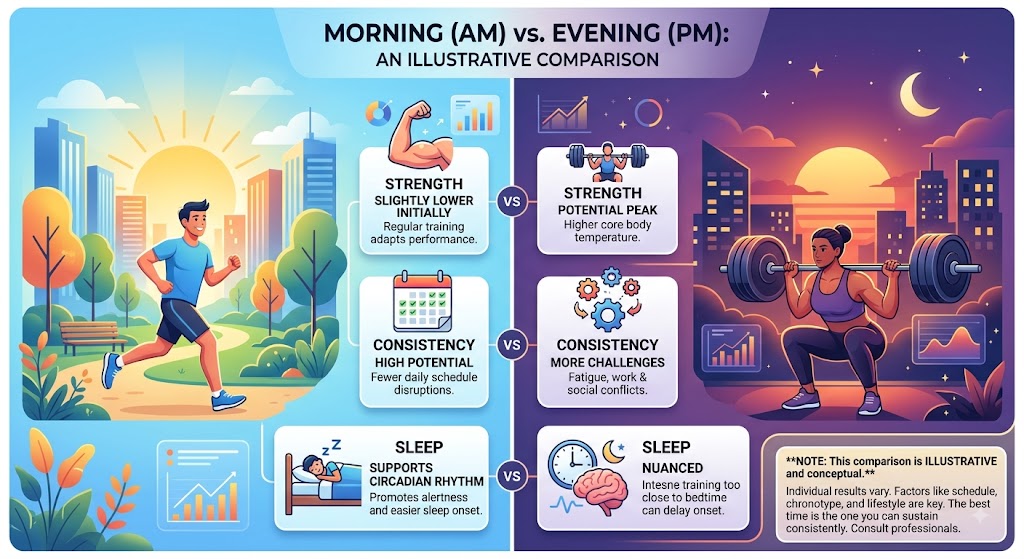
This is the strongest argument by far. Morning exercisers are measurably more consistent, for a simple reason: at 6am nothing has gone wrong yet. No overtime, no last-minute plans, no exhaustion. Evening workouts compete with everything the day throws at you.
Since consistency beats optimisation in every training variable that matters, this alone makes mornings the better choice for many people.
Other Morning Advantages
- Habit formation — a fixed wake-and-train sequence becomes automatic faster than an evening slot that moves around
- Appetite regulation — some research suggests morning exercise is associated with better appetite control through the day
- Emptier gyms — 6am is almost always quieter than 6pm
- Better sleep timing — morning light exposure helps regulate your circadian rhythm
- Done is done — nothing can cancel a workout you finished at 7am
The Morning Downsides
- Lower body temperature means muscles are stiffer — you need a longer warm-up
- Strength is measurably slightly lower in the early morning for most people
- Training fasted can hurt performance on heavy or long sessions
- Requires earlier bedtime — trading sleep for a workout is a bad deal
The Case for Evening Workouts
You're Physically Better in the Late Afternoon
Body temperature peaks in the late afternoon and early evening — typically around 4pm to 7pm. Higher core temperature means better muscle elasticity, faster nerve conduction, and improved joint mobility.
Research consistently shows small peaks in the late afternoon for:
- Muscular strength and power — often a few percent higher than early morning
- Anaerobic performance — sprints, jumps, heavy lifts
- Endurance capacity — slightly better time-to-exhaustion
- Reaction time and coordination
- Perceived exertion — the same workload feels marginally easier
Other Evening Advantages
- You've eaten — glycogen is topped up, so you have real fuel for hard sessions
- Natural warm-up — a full day of movement means you're not starting cold
- Stress relief — training decompresses the workday for many people
- No sleep sacrifice — you're not cutting rest to fit it in
The Evening Downsides
- Life interferes — work, family, and fatigue cancel evening sessions far more often
- Crowded gyms between 5pm and 8pm
- Sleep disruption for some — intense training within about an hour of bed can delay sleep onset in sensitive people
- Decision fatigue — willpower is genuinely lower after a long day
Morning vs Evening for Fat Loss
This is the question most people are really asking, so let's be precise: the calorie deficit determines fat loss, not the clock.
Some studies have found small advantages for morning exercise in appetite regulation and adherence, and some for evening in total work performed. The effects are small and inconsistent across studies. What is consistent: people who train at a time they can sustain lose more fat than people who train at the "optimal" time sporadically.
The mechanism behind the results is still the same: read Calorie Deficit Explained.
Does Working Out Before Bed Ruin Sleep?
For most people, no. Reviews of the evidence generally find that evening exercise does not harm sleep quality, and can improve it — with one exception: vigorous exercise finishing within about an hour of bedtime can delay sleep onset for some individuals.
- Finishing 2+ hours before bed — no issue for essentially anyone
- Finishing 1–2 hours before bed — fine for most
- Finishing under 1 hour before bed — fine for many, disruptive for some. Test it on yourself.
Should You Work Out Fasted in the Morning?
Fasted training doesn't burn more fat over 24 hours — when total calories are matched, fat loss comes out the same. It's a matter of comfort and performance.
- Fine fasted — walking, easy cardio, mobility, short or light sessions
- Eat first — heavy strength training, long sessions, anything where performance matters
- Quick pre-workout option — a banana, a slice of toast with honey, or a small shake 30–45 minutes before is enough
How to Pick Your Time (A Simple Test)
- When can you train 4 times a week without negotiating with anyone? That's your answer 90% of the time.
- When do you have energy? Some people are genuinely wrecked at 6am and sharp at 6pm. Chronotype is real.
- What's your goal? Chasing maximum strength or a PR — lean late afternoon. Building a habit or losing fat — mornings help consistency.
- Do evenings disrupt your sleep? Test two weeks each way and check how you sleep.
- Then keep it fixed. A consistent training time becomes automatic; a floating one requires a decision every single day.
FAQ
Is it better to workout in the morning or evening?
Physically, late afternoon and early evening give a small edge in strength, power, and endurance because body temperature peaks then. Practically, mornings win on consistency because fewer things interfere. The best time to work out is the one you'll keep for months — that outweighs the small performance difference.
Is morning workout better for weight loss?
Not inherently. Fat loss is driven by your calorie deficit, not the time you train. Morning exercise may help slightly with appetite control and adherence, which can indirectly support weight loss, but the timing itself isn't the mechanism.
Does working out at night affect sleep?
For most people it doesn't, and it may improve sleep quality. The exception is vigorous training finishing within about an hour of bedtime, which can delay sleep onset in some people. Finishing two or more hours before bed avoids the issue entirely.
Should I eat before a morning workout?
For light or short sessions, fasted is fine. For heavy strength training or long workouts, eating first will improve performance. A banana or a slice of toast 30–45 minutes beforehand is enough — you don't need a full meal.
What time of day are you strongest?
Most people peak in strength between roughly 4pm and 7pm, when core body temperature is highest. The difference compared with early morning is typically a few percent, and it narrows if you consistently train in the morning — your body adapts to the time you train.
How long should I wait after waking up to work out?
There's no required waiting period, but 20–30 minutes lets your body temperature rise and reduces stiffness. Morning sessions benefit from a longer warm-up — 8–10 minutes of gradual movement rather than the 3–4 minutes you might get away with in the evening.
Where to Go From Here
Whichever time you pick, the plan matters more. Tracqfit builds your training and nutrition targets around your own numbers and schedule — so the session you show up for is the right one.